How Long Is HVAC School? Programs, Costs & Timeline

BrazeJobs Team
Published on 10/19/2026
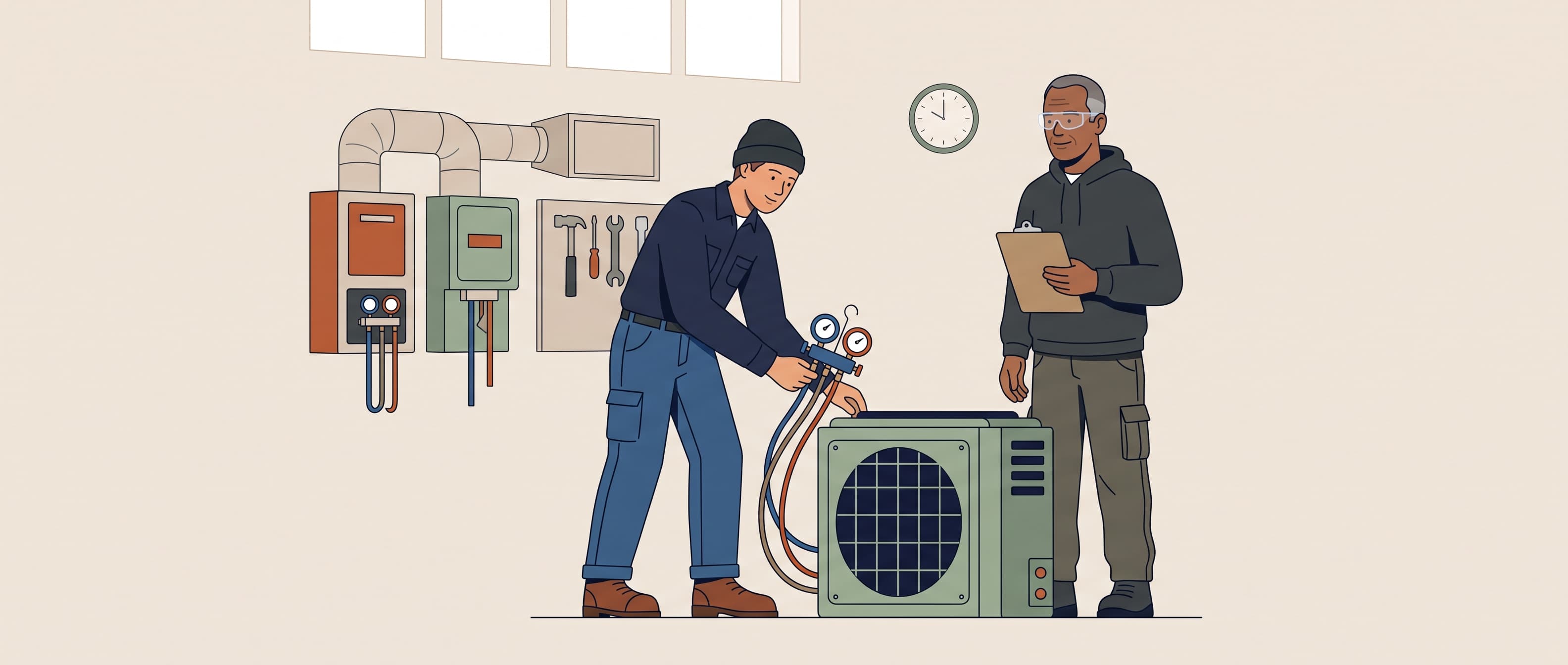
Most HVAC school programs take 6 months to 2 years. A short certificate can be done in under a year, and an associate degree usually takes about two years of full-time classes.
That's the honest answer to "how long is HVAC school," but it's also a little misleading. School is only the first stretch of the road. The part nobody puts on the brochure is that you'll keep learning on the job for years after you graduate, and in some states you can't get licensed until you've logged that time. So let's look at both clocks: how long the program takes, and how long it takes to actually be a tech.
How long is HVAC school, by type of program?
There isn't one "HVAC school." There are a few kinds of programs, and they run on very different schedules. The U.S. Bureau of Labor Statistics says HVAC programs at trade schools and community colleges generally last 6 months to 2 years and end in a certificate or an associate degree. Here's how that breaks down, using real programs as examples:
Program type | Typical length | Example |
|---|---|---|
Accelerated trade school | About 9 to 10 months | UTI's HVACR program: 9 to 10 months depending on campus |
Community college certificate | About 1 to 2 years | Doña Ana Community College (NMSU) HVAC/R certificate: 44 to 45 credits, about a year and a half |
Longer certificate | About 2 years | Manchester Community College (NH) HVAC certificate: 48 credits over five terms |
Associate degree | About 2 years full time | Usually a certificate's trade courses plus general education classes |
Apprenticeship (not school, but it includes classes) | About 4 years | Minnesota ABC HVAC apprenticeship: 8,000 work hours plus 672.5 hours of instruction |
So when someone asks about HVAC school length, the real answer is "which school?" A 9-month program and a 2-year degree both count, and both can get you hired.
Why the length varies so much
A few things stretch or shrink the timeline:

Credits. The bigger the credit count, the longer it takes. A 48-credit certificate isn't a one-semester thing, whatever the name says.
Full time vs. part time. Lots of community college programs run evening or part-time sections for people who are already working. That's great for your bank account and bad for your timeline. How much longer depends on how many classes you take each term.
Summer terms. Some programs keep going through summer, which shortens the calendar. Others take the summer off.
Gen eds. An associate degree adds English, math and other general classes on top of the HVAC courses. That's most of the difference between a certificate and a degree.
Pace of accelerated schools. Private trade schools often finish faster because you're in class most of the day, most days, and they don't break for long summers.
None of these is better by default. A faster program gets you earning sooner. A longer one usually gives you more lab time and more theory. Pick based on what you can afford to do, not on which one sounds more impressive.
What you actually learn in HVAC school
Whatever the length, most programs cover the same core stuff:

Refrigeration cycle basics and how a system moves heat
Electrical theory, wiring diagrams and controls (there's a lot of this, so be ready)
Gas and oil furnaces, heat pumps and boilers
Airflow and ductwork
Reading gauges and taking measurements like superheat and subcooling
Safety, including safe handling of refrigerants, gas and electricity
Prep for the EPA Section 608 exam
That last one matters. Federal rules say anyone who works with refrigerants needs EPA 608 certification. Many schools build the exam into the program, which is one of the real perks of going. But you don't need school to take it. You can study on your own and test with an EPA-approved certifying organization.
If you want a preview of the kind of math you'll be doing, play around with our superheat calculator. If it makes sense to you, good sign. If it doesn't yet, that's what school is for.
How much does HVAC school cost?
This varies a lot, so we'll give you a real example instead of a made-up average.
Manchester Community College in New Hampshire estimates its 48-credit HVAC certificate at $13,540 total for the 2025 to 2026 year at the in-state rate. That's tuition at $230 a credit, plus fees and lab charges. And note what's missing: the school says the estimate doesn't include required tools. Budget for those too.
A few things to keep in mind about cost:
Community colleges are usually the cheaper option, especially at the in-district or in-state rate.
Private trade schools often don't put the price on the program page. UTI, for example, sends you to a separate tuition page. Before you sign anything, ask for the full price in writing, including tools, books, fees and certification exam costs.
Ask about outcomes. Ask what percentage of graduates are working in HVAC six months after finishing, and where that number comes from. A school that can't answer clearly is telling you something.
Financial aid may help. Ask whether the school is eligible for federal student aid, and check whether your state or local workforce programs cover trade training. Some employers will also pay for school if you work for them.
How long does HVAC school take compared to an apprenticeship?
This is the real decision for most people, so let's be direct about it.

HVAC school is shorter, but you pay for it and you're mostly not earning while you're in class. When you finish, you're employable, but you're still a beginner.
An apprenticeship is longer, but you get paid the whole time. The Minnesota ABC (Associated Builders and Contractors) HVAC apprenticeship is a good example. It runs four years, with 8,000 hours of on-the-job training and 672.5 hours of classroom instruction. Apprentices start at 50% of the journey-level wage and get a raise every 1,000 hours, up to 90% in the final stretch.
So school gets you to "hirable" faster. An apprenticeship gets you to "fully trained" with no student debt, but you need to get accepted first, and good programs are competitive.
There's also a third path: getting hired as a helper with no schooling at all and learning on the job. We cover all three in detail in our guide on how to become an HVAC technician.
School ends. The learning doesn't.
Here's the part that surprises people. Finishing HVAC school doesn't make you a licensed technician. The BLS says new techs go through a long period of on-the-job training before they're fully competent. And depending on where you live, the license itself may require documented work time.
Texas is a good example of how school and experience can trade off. To become a Certified Technician through the Texas Department of Licensing and Regulation (TDLR), you need either:
24 months of air conditioning and refrigeration work under a licensed contractor, or
a TDLR-approved certification program of 2,000 hours that combines instruction and practical experience.
Then you pass an exam. So in Texas, the right program can count toward your license. In other states, school might shorten the experience requirement, or it might not count at all. Some states don't license techs at the state level and leave it to cities or counties.
The practical advice: check your state's licensing board before you pick a program, and ask the school directly whether its hours count toward your state's license. Then track every hour you work from your first day on the job. Rebuilding two years of work history from memory is miserable.
Can you do HVAC school part time or online?
Part time, yes. Plenty of community colleges offer evening and weekend schedules. It's slower, but it lets you keep a paycheck.
Online is trickier. You can learn theory online, and online prep for the EPA 608 exam is common. But HVAC is a hands-on trade. You need to braze copper, wire a control board and read real gauges on real equipment. A fully online program with no lab time leaves a big gap, and employers know that. If you go the online route, plan to get hands-on experience some other way, like working as a helper at the same time.
And one firm safety note: gas, high voltage and pressurized refrigerant can seriously hurt you. Don't practice on live equipment you haven't been trained on, and don't treat a video course as permission to work on gas lines.
Is HVAC school worth it? The honest version
School is worth it for a lot of people, but not everyone. Here are the real tradeoffs.
Good reasons to go:
You want to understand why systems work, not just follow steps.
You'd like the EPA 608 handled as part of the program.
You want to stand out when applying with no experience.
Your state counts school hours toward a license.
Reasons to think twice:
You can't go without income. A helper job or apprenticeship pays you to learn. School costs money.
The diploma isn't the job. Your first year in the field is where you really learn. School makes that year less confusing, but it doesn't skip it.
Expensive private programs aren't always better. A cheaper community college program with lots of lab time can be just as good. Compare before you sign.
Debt adds up. The median HVAC tech earned $61,010 a year in May 2025, according to the BLS. That's solid pay, but beginners start well below the median. Taking on heavy loans for a short certificate is a bad trade.
On the plus side, demand is strong. The BLS projects HVAC jobs to grow 11% from 2025 to 2035, with about 40,600 openings a year. For pay at the next level, see our journeyman HVAC technician salary page.
A quick note for Canada
In Canada, the trade usually goes by refrigeration and air conditioning mechanic, and you mostly train through a provincial apprenticeship rather than a standalone HVAC school.

In British Columbia, for example, BCIT's refrigeration apprenticeship has four levels of in-school training, adding up to 990 hours in school and 6,210 workplace hours within a five-year program. Each school level runs 6 to 10 weeks. If you want a head start, BCIT also runs a 25-week full-time foundation program, and graduates who enter the trade within a year can expect credit for level 1.
Other provinces have their own hours and levels, so check with your provincial apprenticeship authority. Refrigerant handling also works differently than in the U.S. You'll need your province's certification instead of EPA 608.
Quick answers
How long is the HVAC program at most schools?
Usually 6 months to 2 years. Short certificates and accelerated trade school programs land under a year. Associate degrees take about two years full time.
How long is schooling for HVAC if you go part time?
Longer than the full-time schedule, and how much longer depends on how many classes you take each term. Ask the school for a sample part-time plan.
How long does HVAC school take compared to becoming fully qualified?
School alone takes 6 months to 2 years. Becoming a fully trained, licensed tech usually takes a few years total, because most licenses and most real skill come from field experience.
Do you have to go to HVAC school?
No. You can start as a helper or apprentice with a high school diploma. School helps you get hired faster and understand the work better, but it isn't required in most places.
Can you take the EPA 608 exam without going to school?
Yes. You can study on your own and take it through an EPA-approved certifying organization.
Is a longer program better?
Not automatically. More lab time is good. More credits you don't need just costs more. Look at hands-on hours, EPA 608 prep and job placement, not just length.
The bottom line
HVAC school takes 6 months to 2 years, depending on the program. That's the fast part. The slower part, getting good and getting licensed, happens on the job, so the sooner you're working, the sooner that clock starts too.
If you can afford it, a reasonably priced community college program plus your EPA 608 is a strong start. If you can't, there's no shame in starting as a helper or apprentice and letting the shop pay for your training.
Ready to start? Browse HVAC apprentice and entry-level jobs on BrazeJobs.
Sources
Manchester Community College: HVAC Certificate Cost Estimate 2025 to 2026
New Mexico State University Doña Ana: HVAC/R Certificate of Completion
Texas Department of Licensing and Regulation: Certified Technician Application
BCIT: Refrigeration and Air Conditioning Mechanic Apprenticeship
BCIT: Refrigeration and Air Conditioning Mechanic Foundation Certificate